
Saturday, August 8, 2020

Life Among the Published

I’ve written previously about clubs and organizations I’ve joined, most of them briefly or with humorous outcomes. Links to those attempts are listed at the end of this essay.

As a member of a local writing support group I was made aware of an upcoming meeting to be held in an historic building across from Millennium Park in Chicago. The monthly meeting of the Society of Midland Authors was open to guests for a five dollar fee. The scheduled panel discussion followed a cocktail hour, a social time for members to mingle with guests and each other. How hard would that be? Drink, talk and listen to a panel of experts without a huge time commitment. In fact, the journey to and from the event took as long as the time between drives.

I invited a great friend who is highly adept at both drinking and talking. As it turned out he likely had better credentials than most of the “authors” in the room, his career being deep within the marketing arm of a regional magazine publishing company. My own linkage consisted of my management position in a corporate ad agency that included oversight of graphic design and writing. So we weren’t entirely crashing the meeting, though it was certainly a lark on a rainy night with nothing better to do.

We spent far more on parking near the Michigan Avenue building than we did at the cash bar on the eighteenth floor where the meeting took place. Exiting the elevator with a swagger and confidence that we felt spoke to our publishing-hood and author-ness, we grabbed a drink and began to mix with the very diverse “Midland” crowd. It turned out that the amount we drank increased in direct proportion to the fun we had with people who became more interesting over the course of an hour.

We discovered a wide spectrum of genres represented among the attendees. Being published was no guarantee of being successful, famous or interesting. Although some of the authors were novelists, most had written on esoteric topics that would only sell to a very narrow niche of friends and family. I swear, one book was a compilation of fabrics, threads and yarns (not tales) through history. The book looked like Pat the Bunny, but not as cute or neatly contained.

Members, either of their own volition or instructed to seek out guests, began to probe us for potential as members.

            “What are you working on?” one tall, bearded author type asked me.

By this time, two Manhattans had me lubed enough to chat up Hemmingway at Sloppy Joe’s in Key West. I was ready to have some fun.

            “Oh, I’ve been working on something for two years,” I said.

            “Really! How fascinating,” he replied.

            “Yeah, I’m a slow reader,” I finished.

He wasn’t sure if he should laugh, perhaps due to an underdeveloped sense of humor, or possibly in an attempt to remain professional and polite, so I followed with,

            “I really prefer books on film.”

            “You’re narrating a book on tape?” he gave me an out.

            “No, I just find that a two hour film is much faster than I can read a book.”

The author member nodded, mouth slightly agape, and moved on to the next guest.

Soon it was time for the panel discussion. The topic was, of course, publishing because that’s what these people live for. On the panel were the Literary Critics for the Chicago Sun Times and the Chicago Tribune, and a woman who ran an independent literary review website called The Bookslut. Her name was Jessa. She had a nose for books, and actually had quite a nose, which may sound mean, but it was hard at first not to be distracted by the sight of the sundial protruding from her face until you started to listen to the words coming out of her mouth. She was by far the intellectual superior to the women working for the two major Chicago newspapers, and despite the rather crudely named website she managed, she had assembled an army of top notch literary writers to provide impressive reviews of all the latest books.

Questions put to the panel invariably centered on how to get published, recommendations for getting the attention of a publisher and marketing strategies subsequent to getting published. Self-publication was still viewed an act of desperation at the time of this meeting, an island of last resort.

The newspaper critics fielded questions to the best of their ability, but their jobs were not as publishers. They were critics and editors who had landed the two best jobs of their kind in the city. Eventually Jessa took a question, and in a moment of frustration said,

            “People need to stop worrying about getting published and spend their energy writing great literature.”

A hush came over the room, and then questions turned back to publishing.

We left the meeting and headed home, having had our fill of this particular society. Once again, I had peeked in through the open window of a group I had no interest in joining, but having satisfied my curiosity was still open to the next adventure.


😎


If you like fiction and you're in the mood for over 50 short stories, please consider buying "Natural Selections," at Amazon.com.


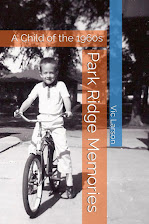
Or if you'd prefer seventy non-fiction stories inspired by a town in Illinois, please consider buying Park Ridge Memories also on Amazon. Click on the image below.


Tuesday, August 4, 2020

The Nun in My Backyard

Today I have a guest author, my daughter Melissa. She wrote this short piece while in school in Lincolnshire, Illinois. The topic is quite unusual, and though we never saw a ghost, the unknown history of the person "buried" in our backyard haunted us and remained a mystery for the seventeen years we lived there.


My dad is really into gardening and making our yard look as impressively green as possible. One spring afternoon at least a decade ago, he was out in the foliage, weeding and raking away the victims of the winter when he found something out of the ordinary. A cross-shaped gravestone marked, “Sister Fabia Fisch February 28, 1892.”

After talking to our elderly neighbor, we found out that the story goes as follows: his sons came home with the marker years ago. They “found” it somewhere. My dad suspects that the stone may have been replaced because the cross style headstones often break at the base. It could have been anywhere when the neighbor boys found it, however, they brought it home, stuck it along the lot line in our back yard, and left it there. Now, my dad weeds around it and tries to keep it looking respectful.

For years, we wondered if there perhaps was a person buried in our back yard. My childish imagination came up with numerous stories explaining the mysterious stone, one of them even explaining that it was a beloved pet fish buried there (you have to expect a young girl to think that based off the name alone). For fun, my dad looked up her name online to see if he could find out anything about who she was. Within the past year, a site was established that has pictures from Maria Immaculata cemetery in Wilmette, Illinois.


Apparently there is a convent with a cemetery where they bury their nuns. There, a new headstone replaces the one lost years earlier.  He also found out that her sister was there as well. Her name was Sister Concordia Fisch. She was two years older, but lived to be 90, unlike Sister Fabia Fisch who only lived to be nineteen.

The Internet is an incredible tool, helping people everywhere find information on long lost nuns thought to be buried in their back yard.


Note from Vic: I have reached out several times to email addresses listed for the convent, but have yet to receive any information in return. I suspect they are very private people but there is a story here, mostly likely a sad one, and we'd love to know more about these early residents of Illinois. Their lives began shortly after the Civil War, and in the case of Sister Concordia, ended when I was five years old.


😎


If you like fiction and you're in the mood for over 50 short stories, please consider buying "Natural Selections," at Amazon.com.


Or if you'd prefer seventy non-fiction stories inspired by a town in Illinois, please consider buying Park Ridge Memories also on Amazon. Click on the image below.


The Election

The day after the election, the U.S. Post Office suspended mail delivery until further notice.

Two days after the election, network television stations and cable outlets ceased operation. All newspapers other than the National Enquirer were shuttered by Executive Order. The heads of the CDC and FCC were arrested, imprisoned and replaced.

Before the polls closed the incumbent declared victory, demanded that he be called “Brilliant Leader” and invoked obscure remnants of the 1918 Sedition Law that allowed for imprisonment of anyone publishing false, scandalous, or malicious writing about him or his government. A celebration event began inside a fortified White House and the President claimed to have been elected by a landslide with the largest voter turnout in the history of the country. An attempt to assume the Presidency by the candidate who overwhelmingly won the popular vote was squelched by a coalition of dutiful Secret Service agents and fearful Generals. The official electoral vote ended with the hanging of the former Vice President. People were later recruited, herded into fleets of buses and driven to the National Mall for the largest inauguration ever held. 

Within two weeks martial law was declared by Brilliant Leader to quell protests, violence and unrest subsequent to his election. All branches of the U.S. Military, including the Space Force, were engaged to imprison as alien combatants any radical liberal, pacifist, socialist or anarchist as deemed necessary by the acting Attorney General, who was appointed Prime Minister. Convoys of loyal supporters blocked key arterial roadways and supply routes for materials necessary for healthcare workers in an exploding but largely ignored pandemic. Voting records were compiled and became the basis of arrests and internment at the state level.

Many within the population withdrew cash from banks, resulting in a shutdown of the financial system. Purchases by credit card were no longer accepted. Shelves at grocery stores emptied. Many stores, boarded up before the election, were torched as rioting and looting ensued. A handful of giant tech companies were declared enemies of the state by Executive Order and were nationalized. Amazon was shut down. The quickest thinkers among us packed our most basic necessities and took to the roads heading for Mexico and Canada only to find borders closed to Americans. All international airlines were overbooked with one-way tickets. And then a series of Executive Orders were issued that established an airline ground-stop, armed checkpoints and detention centers at state borders and the elimination of states themselves. A massive infrastructure project began, building massive walls between the six newly designated national regions, or protectorates, insular areas in which loyal and obedient political hierarchies were established to govern without representation.

It became fashionable to lower the stars and stripes and loft what had been campaign merchandise, a blue, white and red flag that proudly displayed Brilliant Leader’s name, often alongside that of Jesus in smaller, less conspicuous lettering. The states were no longer United. America the Great became the Country’s new official designation. Global leaders reacted with horror and a complete inability to respond with other than carefully crafted statements. Six massive Russian Embassies were constructed, one each in the protectorates. A new national anthem with a strong bass beat and a blazing lead guitar melody was written upon request of Brilliant Leader by Gene Simmons, Ted Nugent and Kid Rock who were subsequently awarded the Leader’s medal of honor. A statue of the late Rush Limbaugh was erected on the National Mall. All references to Barack Obama, Joe Biden and Ruth Bader Ginsburg were ordered stricken from books, electronic media and historical records. Pardons were granted to all indicted or imprisoned associates of the President, himself included.

The Supreme Court was moved into the Executive Branch of the new government and reduced to five justices. The House of Representatives was eliminated and the Senate expanded to 120 seats, also within the Executive Branch. The Presidency became a lifetime appointment, effective immediately.

We searched the radio and television for news during the dark and uncertain period following the election. Numerous regional attempts were made to broadcast over digital airwaves but were quickly shut down. Channel One became the official national news network, or NNN, with frequent folksy cocktail hours hosted by Brilliant Leader, specially selected members of his immediate family, and vocal loyal supporters. Fashion and Design time with the First Lady became a popular segment.

A national health care system finally became a reality, though workers within the system of clinics and hospitals were essentially forced labor, and most surgeries and treatments were outlawed. Abortion became illegal, but so did coronary bypass surgery, appendectomies, amputations and treatment by any kind of medication. Brilliant Leader wanted a population comprised of only the healthiest and least expensive followers. Nursing homes were shut down. The residents were quietly euthanized or sent home to live with willing family members. The sick and aged were declared "losers" by Brilliant Leader.

We nervously watched soldiers and dark green military vehicles parade and conduct exercises in our streets. Homes were occupied as needed. The dreaded pounding on the front door often resulted in public executions by firing squad, often at night. It became difficult to sleep. Backhoes remained in vacant lots for the quick digging of mass graves. Compliance was rewarded with life. Resistance, even hesitation meant death.

Leader’s Day, the new national holiday on June 14th was a mandatory celebration featuring military parades, concerts, Air Force flyovers and food prepared by the citizenry for the armed forces as a mandatory show of appreciation. It was also one of several days throughout the year when massive gates between the six national regions were opened for twenty-four hours to allow visiting between isolated family members. It was promoted as a demonstration of Brilliant Leader's immense kindness. Failure to return within the designated period was considered a capital offense. Stampedes at the wall before and after the opening were large, chaotic and deadly. It was best not to attempt a crossing.

Snow began to fall during the first winter of our national perdition. Our sons and daughters, brothers and sisters turned their guns on one another. Christmas found quiet gatherings of faithful in mostly abandoned churches. Religion was neither encouraged nor prevented but a now famous photo of Brilliant Leader holding the Bible aloft in front of St. John's Church was required in all places of worship. The giving of gifts was difficult in the absence of places to shop, and the new national currency inflated wildly, devaluing constantly. Brilliant Leader’s face smiled from the single printed denomination and one minted gold coin. Alterations began on Mount Rushmore.

We huddled together, peered out at the street from behind perpetually closed blinds and faithfully watched NNN for news from Brilliant Leader. He promised a new reality show called White House Apprentice that he was certain would get the highest ratings in the history of television. We ate what we could find, slept cautiously and answered our door quickly and pleasantly. America was made great again. America the Great. Long life and happiness to Brilliant Leader.

😎


If you like fiction and you're in the mood for over 50 short stories, please consider buying "Natural Selections," at Amazon.com.


Or if you'd prefer seventy non-fiction stories inspired by a town in Illinois, please consider buying Park Ridge Memories also on Amazon. Click on the image below.


Sunday, July 26, 2020

I Won the Lottery

That title is just carefully worded trickery. Now that I have your attention, I did not win the state-run game of chance in Illinois. I never even came close. But when I did buy a ticket I was always filled with a level of apprehension that approached dread.

I did not want to win.

You may have heard stories about lottery winners, the majority of them, who have had their lives ruined subsequent to a major lottery windfall. It’s not hard to imagine why, because money doesn’t buy happiness, right?

Picture the newspaper article and photograph in which you’re holding up a six-foot long fake check made out to you, your name mentioned by a reporter and displayed as a matter of public record. Then imagine your mailbox overflowing with heart-wrenching requests for financial assistance, charitable causes, opportunities for investments, pitches by realtors and financial advisors with offers to “help” you deal with your newly found riches.

Next to arrive are the phone calls and emails. Those who have that information come first, but inevitably some clever hacker will locate you online (it’s not hard) and open the floodgates of Hell. You’ll need to change both addresses and possibly move. Friends and family will develop a barely discernable new relationship with you. The good ones won’t, but finding the bad actors will be painful, like randomly extracting teeth to get at the rotten one.

Something as simple as going out to dinner with another couple might accompany the expectation that you always pay for the meal. After all, you’re a multi-millionaire, right? The ones who offer to pay will be suspect of attempting to influence your undoubtedly generous tendencies, playing the long game, and taking you down a rabbit hole that leads to trust issues, especially if you’re already prone to them.

No, first you need to hire a contractor. Design and build a safe room on your existing house. In it, you will construct a throne, gilded in gold leaf, or perhaps of solid gold. But maybe save the large outlay of cash for the other throne where you’ll read copies of Fortune and Money. At your throne you will grant audiences with the groveling masses, weighing their wants versus needs and doling out small portions of your wealth on the second Tuesday of each month. Your man Jeeves will interview candidates and make appointments when he’s not waxing the Lamborghinis. In other words, live like Bill Gates. 

Stop! Do you see what’s happening? Lottery fantasies! Your road to perdition is being paved and you haven’t yet received your first payment. Note: monthly payouts are preferable to a single lump sum for tax reasons. Again, stop!

What many of us at any at any level of financial means sometimes lack is a concept of “enough.” I know that there are desperately poor people in our country. Did you know that 2 million people in the U.S. lack access to drinking water? Are you aware that 11.9 million children in the U.S. live in poverty? It’s sickening, and I would gladly pay any amount of taxes to make that go away. But then, accused of being a bleeding heart liberal I’m aware that half of Americans would not join me in that cause.

But this article is for my small group of Facebook friends. They all live in homes, have water, electricity, food, clothing, telephones, a computer and Internet access. Considering where we came from not that long ago, we live like kings.

I recently wrote about my realization that I won the Privilege Lottery. I was just born American, white and male in the Twentieth Century. I’m happy to debate that one on one, but based on the almost complete lack of feedback to my article, I entered uncomfortable geography. And of course we also earned what we have through long, hard work or lack thereof.

But it was at Disney World a few months ago, just before the world shut down, that a stranger made a comment that really stuck with me. I was washing my hands in the men’s room at the Yacht Club Resort, about to enjoy a delicious breakfast at Ale & Compass restaurant. Now, I’m fully aware that talking to someone in the bathroom is not cool, but a Black pastor stepped up to the sink beside me to wash his hands. Did it matter that he was Black? No. Did it matter that he was a pastor. I think it did.

            “Good morning,” I said.

            “Good morning,” he replied, “How are you?”

            “I’m great, how are you”

            “Better than I deserve,” he said.

“Better than I deserve.” How many of us can say that? How many of us should be saying that?

As I approached retirement I had another short conversation with a retired gentleman a few years older than me. He was consulting at our company. Oddly enough, we were returning from the bathroom, that catalyst of deep thinking, at least in my experience.

            “So, Tom, tell me about Social Security. Take it early or wait?” I asked.

            “Take it. A friend of mine waited and died before collecting a penny.”

The very sad outcome of this exchange is that Tom had terminal cancer, which he discovered within weeks. He died six months later. I know of numerous others who continued to work, stretching for that ever-moving goal of “enough” only to wind up disabled or dead before arriving.

My mother died at age fifty-five. My father died at fifty-nine. They never enjoyed a minute of retirement. So when my wife had brain surgery to correct an aneurysm, also at age fifty-five, any rumination we’d discussed about our future sharpened to crystal clarity. With some careful planning and a willingness to move cross-country, we felt we had enough to be very comfortable.

It is hard to be far from family and lifelong friends. It is challenging to share one car. But most things considered, I realize that we are lucky to enjoy each day, each other and a future for which we remain hopeful. Waking up in the morning is a good thing. I am thankful, grateful and often humbled as aging reminds me that I am not the man I used to be. But then again, if you ask me how I’m doing, I now reply, “Better than I deserve.”


😎


If you like fiction and you're in the mood for over 50 short stories, please consider buying "Natural Selections," at Amazon.com.


Or if you'd prefer seventy non-fiction stories inspired by a town in Illinois, please consider buying Park Ridge Memories also on Amazon. Click on the image below.


Thursday, July 16, 2020

Got Privilege?

In order to free ourselves from racial prejudice we first need to rise above our nature as tribal creatures. You think you’re not tribal? Look in the mirror. What do you see?

In my case, the reflection is a white, male, heterosexual, Baby Boomer, Lutheran, American of Swedish ancestry, and graduate of Maine South and the University of Illinois. This doesn’t account for political affiliation, employers, fraternity, sports team preference, or other organizations I’ve joined.

Which of your many tribes would you fight and die for? I know Green Bay Packers fans that would take up arms to defend their identity. I would fight for my country and my family, but I doubt very much that I would jump into a trench for the U of I or Sweden. But at some level, when push comes to shove, we need to feel superior to someone else. Sadly, it’s just the way humans are wired.

I now live in a place some continue to view as part of the former Confederacy. The news is currently filled with images of that reconciliation. I recently drove behind a truck that was plastered with emblems and flying an actual Confederate flag from the rear bumper, as if to say, “I continue to stand for the wrong-headed, traitorous movement that lost the Civil War.” But that’s judgmental. It’s their tribe, and as another flag they like to wave from an earlier war aggressively states, “Don’t Tread on Me!”

We also need to gain an understanding of the privileges many of us take for granted –white, male, or otherwise.

My only experience as a minority was during a month I spent volunteering for Earthwatch in Honolulu, Hawaii. I was considered a “Haole” (how-lee.) This is a term usually applied by native Hawaiians or Polynesians to Caucasians. It is not necessarily derogatory, depending on context, but it is often negative. It was an eye-opener that kept me on my guard. Living there permanently would mean adjusting to the notion of always being viewed as an outsider, with limitations on my rights and sidelong glances from those who dislike me without knowing me. But at the end of the month, I was able to simply fly back to my privileged place on the Mainland and resume where I’d left off. Even police can take off their uniforms at day’s end and get a break from scrutiny. But people of color cannot for a minute remove their skins.

I am surprised that the 1964 film  Black Like Me has not been pulled out of the archives and re-popularized. Based on a true story, actor James Whitmore plays reporter John Griffin, who went through treatments to darken his skin for a six-week tour of the southern United States in the 1950s. It is the ultimate blackface experiment and well worth watching.

I’ve encountered a wall of denial built around my white male friends. The suggestion that we have benefited from white privilege, particularly as males, sometimes triggers an angry, defensive response. One pointed to a life of hard work (earned privilege) and a less-than-privileged upbringing as a latchkey kid. The key to that latch on a door to a house owned by one or more parents undermines his claim.

Everyone I know lived in a home with one or more parents. That is privileged in itself. This generally leads to statements like, "Poverty is a choice," and how "those less fortunate need to pick themselves up by their bootstraps and stop living off of the welfare state funded by our taxes.”

            “But they might not have boots, or straps,” I say.

Speaking in metaphors is never a good way to advance a debate. And the failure of my friends to recognize that they benefit from an invisible collection of unearned social assets is not their fault. Privilege itself is not their fault. We have been conditioned to be oblivious to our advantages. But failing to acknowledge those privileges is definitely our fault.

I am fully aware that I benefited from being a white male early in my career and in life (unearned privilege). As a young man in my early twenties, I was able to stroll into a bank and secure a mortgage, having only recently graduated from college. The house I mortgaged was in an affluent north suburb of Chicago. I felt safe in my neighborhood and had pleasant neighbors. There was almost no crime. My high school class numbered around 1200 racially similar students. Our teachers looked like us. At the end of the day, we turned on the television and saw people that looked like us. Our entire world looked like us. We took it for granted.

I waltzed into college, able to afford the cost and without much in the way of scholastic credentials. Many of my friends had help from their parents. We were not the first in our families to pursue higher education. We were financially and intellectually privileged. I was raised by two parents, with a father who was present and a life free from generational poverty, substance abuse, and violence. Maybe I was just lucky.

I later applied for and was promoted within a large corporation without much effort. I worked hard, but hard work is entirely separate from the privilege that eased my journey.

And then came the day when my company rolled out an initiative that included hiring percentages for women and minorities. This was long before the acronym DEI became popular. The rug of privilege was suddenly seemingly pulled out from under me. The corporate ladder had a few new rungs upon which I was not allowed footing. I challenged what I considered “quotas” and in a meeting with a Black, female HR representative the new reality was firmly but politely made clear. I was handed a booklet on Affirmative Action and sent on my way. But before I left, that very nice young lady asked me:

            “Can you imagine what it’s like to feel that people assume I got my job because of my race or gender, or to have to work twice as hard as someone else to be considered for a job?”

I couldn’t imagine that. My latchkey friend says that this isn't true. Everything is already equal. But her comment spoke to the essence of being unprivileged.

Politicians as far back as Nixon have employed a “Southern Strategy” of focusing on racial issues to gain votes from a fearful white working class. It’s a real vote-getter, but as our national demographics evolve, the strategy is beginning to backfire. The assumption is that a gain in privilege by one race is part of an equation that results in a loss by another. Is that true? Is privilege a social currency that can neither be created nor destroyed – it just changes hands? Or can we learn to share?

Every so often our society lurches forward in a spasm that seems like a great awakening to those of us who were on autopilot. Changes come quickly, two steps forward, and are often met with eventual resistance when things get uncomfortable, three steps back. There can be collateral damage when boundaries extend into the marginal gray zones. The #MeToo movement tapped into a sweeping “cancel culture” that may have disproportionately held a few people overly accountable, but mostly not. This is a literal push coming to shove that bumps up against our tribal personal bubble.

            “They tore down which statue? Well, that’s not right.”

            “Al Franken resigned? But he was just joking!”

            “Change the name of the Redskins? Why? That seems silly.”

            “Aunt Jemima is a wonderful childhood memory. Gee whiz.”

            “Black lives matter.”

            “Blue lives matter.”

            “All lives matter.”

Silly perhaps to some, but not to others. After all, cultural appropriation is nothing new. European Whites demanded it of Native Americans. Speak our language. Adopt our traditions. This land is our land…now.

If you read any amount of honest history you’ll find that much of this is not at all new. The rich tribe has always needed the poor tribe to generate their wealth. The rich amass power, become leaders, draft legislation, and pass laws that benefit their position. Having become privileged they are not about to give it up. Those of us in the shrinking center enjoy our relative comfort and level of privilege. And we don’t want to lose it either. We’re part of a tribe called the Middle Class.

My latchkey friend told me that true history is not being taught. I assumed that he had been made aware that between 1885 and 1915 on average every third day a Black person was brutally, publicly murdered by white mobs. But my hope evaporated when he said that many slaves weren’t Black, and were well-treated indentured servants. As if that makes owning another human acceptable.

Darwin might say that tribalism carried with it genetic survival value. Competition between tribes over preferred resources, land, and mates undoubtedly resulted in a stronger tribe and possibly a more diverse and healthier gene pool. That's a short detour to a road called "Eugenics."

But just as we eventually evolved language, religion, a conscience, moral values, and laws, hasn’t the time come to eliminate the barriers that prevent us from viewing each other as members of a single human tribe? Perhaps not even very soon, but we can begin to lay the foundation and framework for a future when that hopefully comes to pass.


😎


If you like fiction and you're in the mood for over 50 short stories, please consider buying "Natural Selections," at Amazon.com.


Or if you'd prefer seventy non-fiction stories inspired by a town in Illinois, please consider buying Park Ridge Memories also on Amazon. Click on the image below.


Saturday, June 27, 2020

User Error

Those of us who worked at The Company still talk about the time when investors negotiated a takeover of our profitable enterprise. We didn’t know it at the time, but these unseen entities were not simply injecting cash for a share of profits in our booming business. This was an acquisition, and things were about to change.

It had all seemed too good to be true, and even the owners seemed dismayed and betrayed by the sudden onset of cost cutting and the rapid purge of amenities. They had spent years building the business and nurturing the loyal employees who helped make them successful and wealthy. They were emotionally invested, but only to a point.

How could we know that our decent pay, high morale and sunlit fourth floor office would soon be darkened by an attention to the bottom line worthy of Jacob Marley’s scrutiny? Gone would be the monthly birthday gatherings in the central conference room, festooned with colors, cake and congratulations. Our weekly chair massages were the first thing to go. The owners were next.

And then the layoffs began; a few at first, and then with greater frequency. The investors could spot a successful business but had no idea how to run one. Morale and relationships begot sales, which in turn begot profits. Once morale tanked and favorite employees began to jump ship, customers shifted accounts to firms more like the one we had once been.

Rumors of an eventual large layoff circulated for weeks in hushed tones around the office. Savvy staff had already moved on, leaving the less seasoned among us to hope for a reprieve, a delay or some good old-fashioned luck. But the ax had been used to sharpen pencils, and spreadsheets were constructed with exquisite detail for review and an imminent blood letting. Friday would be blackened, and it was already Thursday.

Early that afternoon, an email blast appeared throughout the office, here and there accompanied by subtle chimes. Whispers followed, and then scurrying footsteps as staff ran between cubicles to stare together in horror at an attached file that was being saved to local hard drives.

“SHUT DOWN THE SERVER!” came a scream from a Vice President’s office down the hall. But it was too late.

Everyone in the office was in possession of an organized spreadsheet accounting of the next day’s layoff. Column by column, row-by-row, staff was reduced to numbers that told the story of their demise. Salaries, severance and savings, totaled and sub totaled, tallied for the investors and laid out like so much beef in a butcher’s counter, complete with white paper and twine.

As the story unfolded, an email distribution group titled “All Company Management” was alphabetically arranged next to the distribution group more appropriate for company newsletters named “All Company.” The mistake was honest, inexcusable and part of company lore for years to come. One click of the mouse selected the distribution group. A second click sent it irretrievably to everyone at The Company. Lacking a final warning that said, “Are you sure you want to send a note to all staff?” the mistake was one of inattention to detail at a moment when caution was paramount. And the incident changed nothing. The cake had been baked, but was now frosted with a thick layer of shame and humiliation for one of the few who didn’t lose her job that day. She was allowed to stay.


😎


If you like fiction and you're in the mood for over 50 short stories, please consider buying "Natural Selections," at Amazon.com.


Or if you'd prefer seventy non-fiction stories inspired by a town in Illinois, please consider buying Park Ridge Memories also on Amazon. Click on the image below.


Thursday, June 18, 2020

The Hinges of Hell

My neighbor has a saying for everything. I’m a fan of fun sayings so I thought I’d start a collection. My favorite, spoken frequently by author and radio show host Garrison Keillor is, “The desire to perform is no indicator of talent.”

I’ve repeated that line so many times and in so many places I can no longer categorize its use. It’s a great one for school variety shows, amateur theater productions and chorales, church choirs, political debates and even sporting events. Put me in coach. No, you stay on the bench!

It’s another way of saying, “Just because your head is shaped like a hubcap doesn’t mean you’re a big wheel.” That one belongs to neighbor Jim. I look forward to capturing more of his folksy wisdom. Now that he knows I’m taking notes they’re flying fast and furious.

My grandmother had favorite phrases for lots of occasions. I only wish I’d written them down instead of relying on my memory.

One of hers was, “What falls to the floor comes to the door.” I guess saying this is a nice distraction for clumsy types to get observers thinking about something other than picking errant silverware off of the kitchen floor. Is a knife a man, a spoon a woman? How does that work? Does it ever work? I mean, “I was born at night, but not last night.” Don’t expect me to stand by the front door and await guests every time you lose your grip on a fork.

Another of Grandma’s favorites was, “Friday night dreams come true.” I’ve never tested this, but feel free to keep a notepad on your nightstand and tape your nocturnal imaginings to the refrigerator for future reference. How long does it take for these dreams to materialize? If I master lucid dreaming can I take advantage of this cause and effect?

I’ll be updating this from time to time. Summer is a good time for inside activities like this. To go outside is foolish when it’s “Hotter than the hinges of Hell.” One interesting note: Hell’s Hinges is a 1916 silent film featuring William S. Hart and Clara Williams. Now you know.

I’ll end with a classic line by my favorite humorist, Mark Twain. He said, “It is better to keep your mouth closed and let people think you are a fool than to open it and remove all doubt.”

With that, I will close my mouth and suppress my desire to perform further.


😎


If you like fiction and you're in the mood for over 50 short stories, please consider buying "Natural Selections," at Amazon.com.


Or if you'd prefer seventy non-fiction stories inspired by a town in Illinois, please consider buying Park Ridge Memories also on Amazon. Click on the image below.


Tuesday, June 16, 2020

Packing for a Trip to the Third World

Drafted mentally at 3am on a sleepless night at the Hotel Bambu in Santiago, Guatemala. Completed in a traffic jam on a hill outside of Panajachel after a particularly bouncy boat ride.

I begin this essay with the observation that I’ve never known a rooster to crow exclusively at sunrise. At least three confused cocks interrupted my sleep with what can best be compared to “The Midnight Howl” from the movie 101 Dalmatians. Gallo Frito (fried rooster) is my dish of choice should I decide to hold them accountable.

Eight months of planning afforded this compulsive worrier plenty of time to prepare for the horrors of our descent into the heart of darkness. My Third World checklist resulted from ruminations of car-jackings, robberies, machete assaults, pick-pocketing, volcanoes, earthquakes, cliff-falls and other random surprises over which I have no control. That left me to focus on exchange rates, parasites and a variety of possible rashes. And, yes, I know that it’s never the things you expect or prepare for that deliver your undoing.

My packing list became quite specific. If I can catch jock-itch and athlete’s foot at a health club two blocks from my home, then the devilish Tinea twins can easily stage a third world Cincoanera in my nether regions without an ample supply of Tinactin and Lotrimin. Check.

Hydrocortisone seems an appropriate addition for a variety of potential skin eruptions, not the least of which might be the result of exotic plant scratches and insect stings. And speaking of eruptions, I think it only logical when surrounded by volcanoes and water borne parasites to have a well considered, shall we say, exit strategy.

Seriously, the metaphor of magma exiting my body, jet propelled by an assortment of unaccustomed foods, laced with picante, pico de gallo and hot peppers is a short stretch given my propensity to suffer digestively in travels to my only previous Third World destinations like Round Lake Beach and Peoria. Compounding this is a lifetime aversion to objects falling from my body that harkens back to my toilet training resistance as a child, continuing into middle age with a diet high in beef and output that more closely resembles an Arabian foal. Wet wipes and lidocaine cream applied as needed. Check.

All of this brings me to our painful ride on Lake Attitlan, a water filled collapsed caldera between three volcanoes, in a rustic flat bottom boat not meant for even light chop. Halfway through the slamming ordeal, tossed like our luggage and seat cushions I shouted “No mas testiculares” in a plea for mercy on my gonads and an attempt to sound Spanish. I fully expected to be hurled from a volcanic vent on a Mayan altar like James Mason and Pat Boone after their Journey to the Center of the Earth, but had no such luck. Where is Arne Saknussemm when you need him?

Respectfully submitted should the mosquito bite I suffered on the last day of the trip result in Dengue Fever or something equally awful and untreatable.

But of course it didn’t. Like most vacations, it was extremely enjoyable and utterly amazing – in hindsight.


😎


If you like fiction and you're in the mood for over 50 short stories, please consider buying "Natural Selections," at Amazon.com.


Or if you'd prefer seventy non-fiction stories inspired by a town in Illinois, please consider buying Park Ridge Memories also on Amazon. Click on the image below.


Sunday, June 14, 2020

Shaman Bob


Introduction:


Allow me to introduce a story that can best be characterized as imaginative nonfiction. As the first authorized biography to be written about its subject, much literary tuck-pointing was required to fill gaps in a previously unknown but amazing story. By agreement, no sources are cited, and any legal records that might support the legitimacy of the story have been expunged. But it is mostly the truth, and we leave it to you to decide where that gets in the way of fabrication.


Shaman Bob is a prophet among prophets. He is in human form while he traverses the world through place and time, but suspects himself to be of otherworldly origin. He is a blissful being with a personality too codependent to become angry or vengeful. His influence spans generations and continents. He is wise and all-knowing, though he remains humble and without pretense. In fact, his magniloquence has left others with the impression that he is somewhat obtuse. He claims to be God’s best friend.


Emerging from the ritual purification of Temazcal after consuming numerous Ginkgo-infused Long Island Ice Teas, Bob experienced a series of visions that led him to embrace his destiny as a Shaman. But more about that later. It is important for you only to understand that Shamanism is not a birthright, certification, or online degree from the University of Phoenix. It is a mindset and lifestyle choice adopted infrequently but consistently across human cultures and throughout history. Shaman Bob decided he was a Shaman and that was that.


To read the rest of this story and more than fifty others, please consider buying Natural Selections on Amazon. Click on the image below.


Or if you'd prefer seventy non-fiction stories inspired by a town in Illinois, please consider buying Park Ridge Memories also on Amazon. Click on the image below.


Saturday, June 13, 2020

Worlds at War


The red planet burned in the evening sky and the in dreams of Edward Walter Maunder. He stood in the garden of his London home gazing skyward as he did frequently on clear and moonless summer evenings, mired in a debate over his opinion regarding the true nature of Martian canals. His obsession with the red orb, the most masculine of planets, tested the limits of his scientific knowledge, and he inevitably turned in frustration to the telescope in his greenhouse. It remained there, equilibrated to the outdoor temperature to reduce fogging of its highly polished lenses.


It was at one of the early meetings of the British Astronomical Association that Edward crossed paths with Herbert Wells, fifteen years his junior, but a decidedly deeper thinker and consummate debater. Wells and Maunder shared tea frequently over the course of several years as neighbors, developing a deep and intellectually satisfying friendship.


To read the rest of this story and more than fifty others, please consider buying "Natural Selections," at Amazon.com.


😎


If you like fiction and you're in the mood for over 50 short stories, please consider buying "Natural Selections," at Amazon.com.


Or if you'd prefer seventy non-fiction stories inspired by a town in Illinois, please consider buying Park Ridge Memories also on Amazon. Click on the image below.


Tuesday, June 9, 2020

Nothing Good


“Don’t ask,” grunts my contact as he swings open a chain link gate and motions me inside.

Of course, I never ask. To do so would be unprofessional, and if my fledgling business needs anything at this point, it’s a profound level of trust, and a track record that will get me other jobs by word of mouth.

The unsavory nature of my growing list of clientele speaks to my competence, both as a security analyst and as a tight-lipped confidant among night-dwellers in the underground economy. I am generally paid in cash. Hundreds only.

We’ll call my contact Vinnie. Yeah, Vinnie. He ushers me into the compound and promptly chains and locks the gate behind me. We head to the first of a series of storage sheds. Barn sized and windowless metal structures, allegedly protected by “Fang,” an ancient Doberman Pincer who looks up and woofs in our general direction, then licks his balls before lying back down in the dust near shed one. The Beware of Dog sign on the fence has done far more to guard the area than Fang for quite some time. I guess that’s why they need me.

Inside shed one, Vinnie flips on a series of incandescent hummers, caged steel contraptions that immediately attract moths and illuminate airborne dust. 

😎


To read the rest of this story and 50 others, please consider buying "Natural Selections," at Amazon.com.


Or if you'd prefer seventy non-fiction stories inspired by a town in Illinois, please consider buying Park Ridge Memories also on Amazon. Click on the image below.